

Book a demo
Get started
.png)
Hybrid work didn’t just change where people work.
It quietly changed how the workplace experience is created and where it breaks down.
Most conversations still focus on flexibility, well-being, or return-to-office policies. But there’s a more operational shift happening behind the scenes: workplace experience is no longer designed, it’s observed.
And that changes everything
For years, workplace experience strategies were built on intent:
But hybrid work introduced unpredictability. Employees choose when they come in, who they meet, and how they use spaces. As a result, the gap between how offices are designed and how they’re actually used has never been wider.
Gartner’s latest research reflects this evolution: workplace experience applications are increasingly expected to provide real usage insights, not just employee-facing features.
The shift nobody talks about?
Experience now depends on visibility.
When organizations lack clear signals on what’s happening in the office, experience suffers. Silently.
At Comeen, this usually shows up in very concrete ways:
None of these are “experience problems” on paper. But in practice, they shape how people feel about the office: frustration, friction, wasted time.
And they all come back to the same issue: no shared, real-time view of space usage.
If one space reveals this shift more than any other, it’s the meeting room.
According to Gartner, meeting spaces remain among the most business-critical assets; yet also the least efficiently used. Comeen data confirms it: large organizations can recover up to 31% of unused meeting room capacity simply by improving visibility and usage signals.
What changes experience isn’t adding more rooms. It’s making usage obvious:
When meeting rooms work smoothly, the workplace feels organized. When they don’t, everything feels harder than it should.
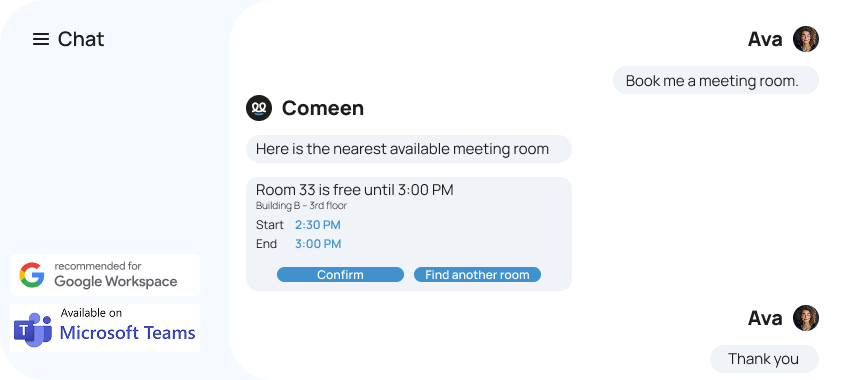
The next phase of workplace experience isn’t just digital. It’s assisted.
Gartner highlights a clear evolution: workplace experience platforms are moving toward AI-powered assistants and agents that help employees navigate their workday, rather than asking them to constantly manage tools and interfaces.
At Comeen, this is exactly how we think about AI in the workplace: not as a layer on top of experience, but as a quiet assistant embedded in everyday interactions.
In practice, that means AI supports experience where friction usually appears:
The goal isn’t to showcase AI.
It’s to remove unnecessary decisions and micro-frustrations from the workday.
By designing AI as an assistant that operates within familiar environments, like calendars, chat tools or meeting rooms themselves. Comeen helps make the workplace experience feel intuitive rather than automated.
When AI is aligned with real usage and real contexts, it stops being something employees “use” and becomes something that supports them without being noticed.
AI doesn’t improve workplace experience on its own.
Data does.
Gartner emphasizes that effective workplace experience applications rely on continuous, reliable data streams from calendars, room usage, occupancy signals and employee interactions.
Without strong data foundations:
With the right data, experience becomes adaptive:
At Comeen, this is where workplace experience becomes measurable. Usage data doesn’t just inform IT or real estate teams it directly shapes how employees perceive the office: smoother, clearer, easier to navigate.
In that sense, data isn’t a backend concern.
It’s the invisible layer that makes workplace experience feel intentional.
Another part of this shift often underestimated: experience can’t live only inside apps.
Gartner highlights that workplace experience platforms must reduce cognitive load. In reality, that means not asking employees to constantly check tools, dashboards or booking systems.
This is where digital signage becomes strategic:
A screen showing what’s happening in the office, right now, often does more for experience than another feature hidden behind a login.
The most important shift is this:
workplace experience is no longer just an HR or culture topic. It’s operational.
It lives in:
Gartner’s research reinforces this direction: organizations that treat workplace experience as a measurable, data-driven layer (not a vague initiative) are better equipped to support hybrid work sustainably.
The future workplace experience won’t be defined by perks or policies. It will be defined by clarity and experience.
The companies that get ahead will focus less on designing the “perfect office” and more on:
Because the shift nobody talks about is already happening, whether organizations act on it or not.
The workplace experience shift isn’t about adding more tools or more technology.
It’s about making the workplace understandable, responsive and easier to navigate.
As hybrid work becomes the norm, experience is no longer defined by intention or design alone. It’s shaped in real time, through usage data, visible signals and AI assistants that quietly support employees throughout their day.
When AI is grounded in real workplace data, it stops being a feature and becomes part of the experience itself: helping people find the right space, removing friction before it appears, and letting the office adapt to how work actually happens.
The organizations that will get workplace experience right won’t be the ones talking the loudest about AI. They’ll be the ones using it to create clarity: where spaces make sense, information is visible, and the workplace simply works.
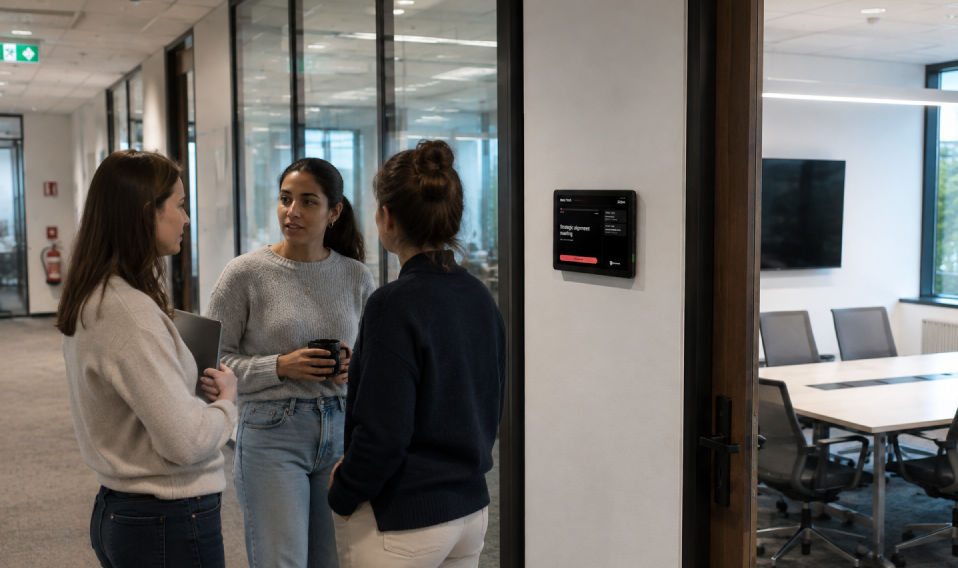
Space management creates more value when workplace data and employee experience work together. By connecting space usage, operational insights, and access to workplace services, organizations can better understand and optimize their spaces while making the workplace simpler for employees.

Hybrid work creates new workplace challenges, but the right approach can improve employee experience. Here are seven key features that help reduce friction, simplify office days, and create a more seamless workplace experience.
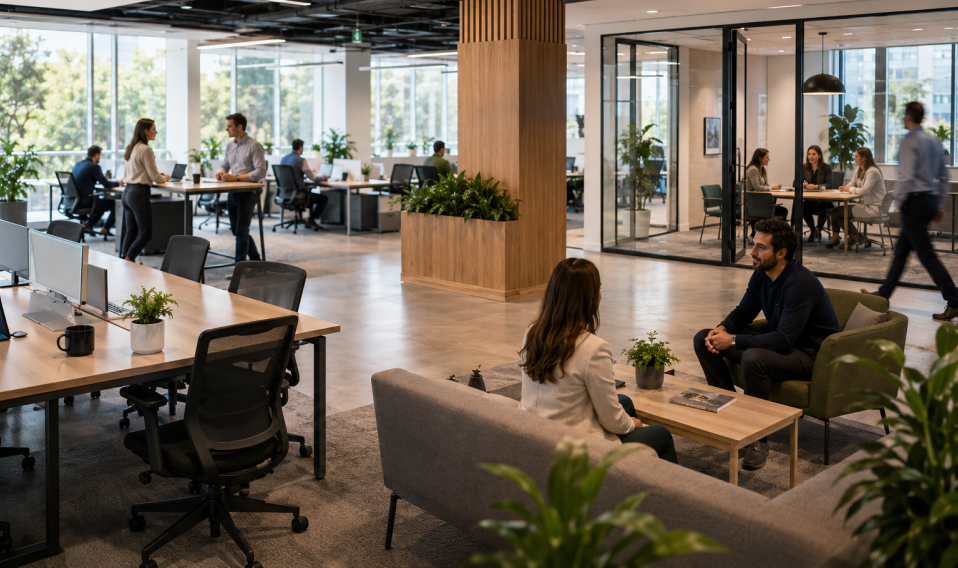
Hybrid work has transformed workplace management, making real-time space visibility, flexible booking, and workplace analytics essential for optimizing office usage, employee experience, and real estate costs.